
About our bagels
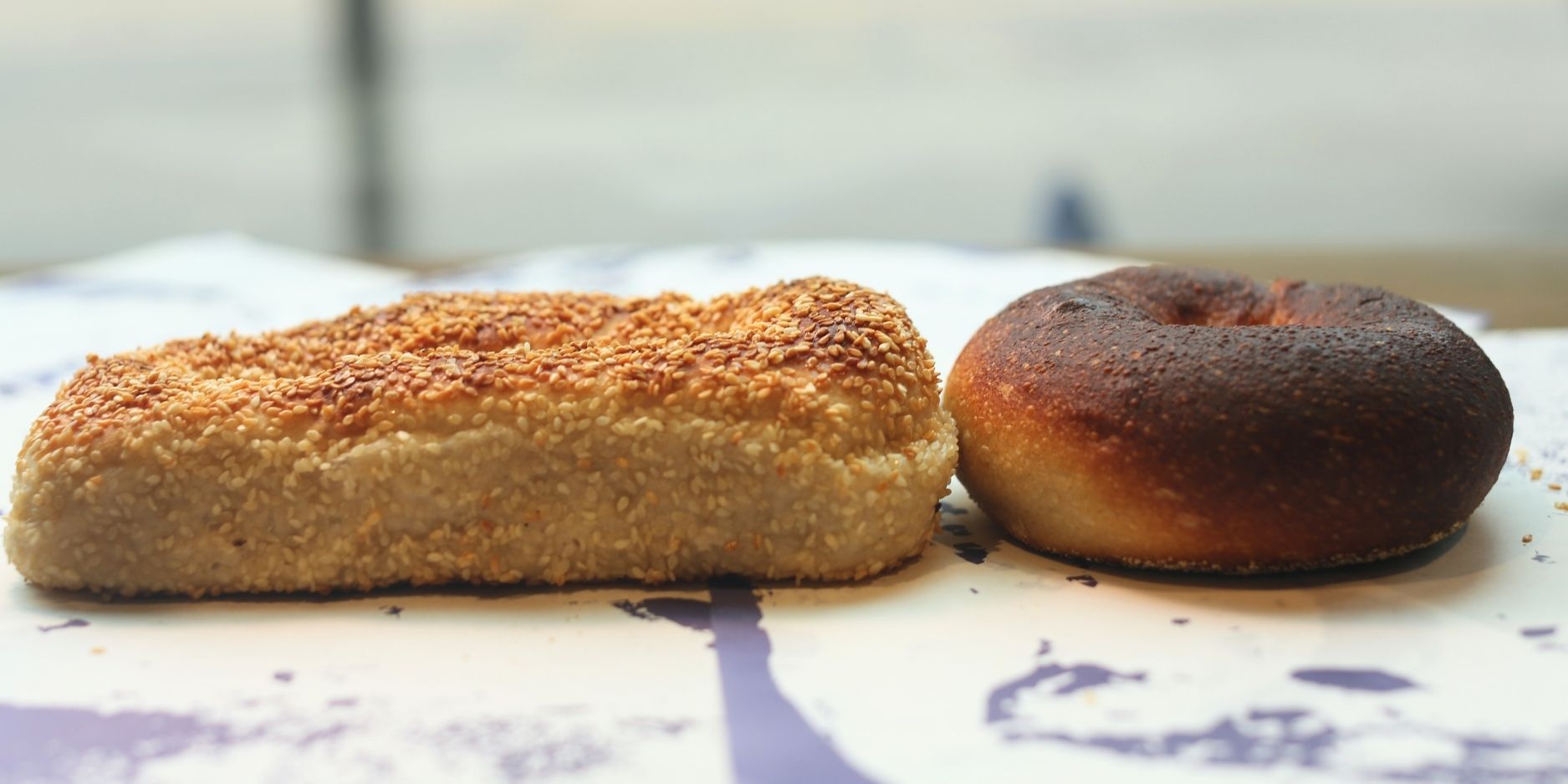
The Razava Bagel and the Jerusalem Bagel, both sourdough.
Bagel people love a debate.
New York or Montreal? (New York, obviously. But we still love you, Canada.)
Toasted or untoasted? (Untoasted...usually.)
Butter or schmear? (Schmear on a fresh bagel. Butter once it's a few days old, when it's okay to toast.)
Whether a bagel made anywhere but New York counts as a bagel at all? (Absolutely.)
And whether the key to a great bagel has to do with the tap water? (Absolutely not.)
To us, the only question that matters is: Razava or Jerusalem?
Those are the two kinds of sourdough bagels we make — a round NY-style one, and a long sesame-studded one.
What's the difference between the Razava Bagel and the Jerusalem Bagel?
Shape:
Razava Bagel: Round, with a small hole
Jerusalem Bagel: Long oval
Dough per bagel:
Razava Bagel: 140 grams
Jerusalem Bage: 200 grams
Size:
Razava Bagel: About 4 inches across
Jerusalem Bagle: About 7 inches end to end
Fermentation:
Razava Bagel AND Jerusalem Bagel: 12–18
Outside:
Razava Bagel: Baked dark
Jerusalem Bagel: Coated in sesame seeds, brushed with olive oil
Inside:
Razava Bagel: Dense and chewy
Jerusalem Bagel: Soft and airy
Made for:
Razava Bagel: Slicing, schmearing, sandwiches
Jerusalem Bagel: Ripping, dipping, sharing
The Razava Bagel: our take on New York
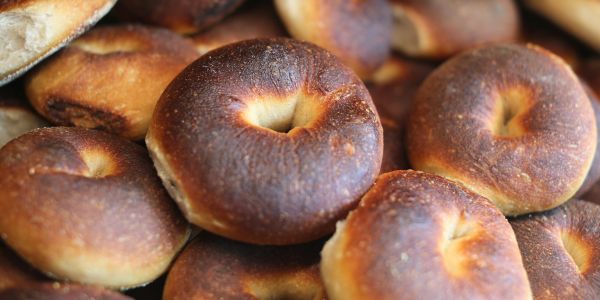
Ask most people to describe the perfect bagel and you'll get the New York one: a thin, almost crackly outside, a dense, chewy, malty inside, and a hole small enough to leave plenty of room for schmear.
The problem for us was how that bagel gets made. It's typically a stiff dough of very strong, high-gluten flour with very little water in it, which is almost exactly the opposite of how we bake. So when we opened in 2024, we set out to make a New York-style bagel the Razava way: high hydration, long fermented, and baked dark.
The answer started with a scald, the same technique we use in our Pain de Mie. Cooking part of the flour with water first pre-gelatinizes its starches, so the dough can take on a lot more water and still handle like a stiffer one. That's where the chew comes from, without the heaviness.
The bagels get a long, cold fermentation, a warm final proof, a short chill, and a very hot oven with plenty of steam, and we bake them past golden to a deep, burnished brown.
For a year and a half we called it the NY Bagel. Somewhere along the way it stopped being a New York bagel and became ours, so now it's the Razava Bagel.
The Jerusalem Bagel: long, soft, and coated in sesame
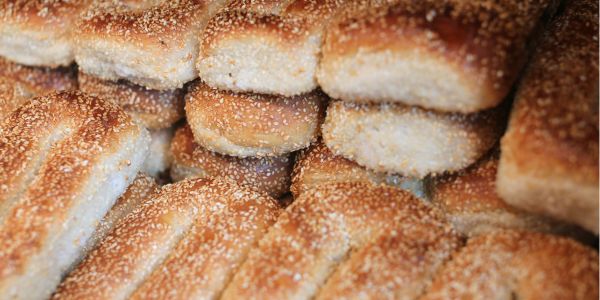
The Jerusalem bagel looks nothing like most bagels in North America. It's a long oval, and it's completely coated in sesame seeds, enough that the sesame is part of the crust.
The name comes from where it's commonly sold, piled on carts and hung on strings in Jerusalem's Old City. Breads like it have been made for generations across the Middle East, where versions go by ka'ak or simit.
Ours goes back to a round-the-clock bakery in Haifa. After concerts let out, after the bars closed, after everything else in the city had gone dark, people lined up outside Hershko's Bakery for fresh bagels. They made two kinds: sesame, and salt (a light "kiss" on one side). We make the sesame one, and we serve it during more reasonable hours.
The dough is enriched with olive oil. We shape it into ovals, submerge them in sesame seeds, give them a warm final proof, and bake them in high heat. When they come out of the oven, we brush them with olive oil. At 200 grams of dough each, they're about 40% bigger than our Razava Bagel, and softer and fluffier inside.
Are both bagels sourdough?
Yes. Everything we bake is sourdough, and that includes both bagels. Our starter, a living culture of wild yeast and lactic-acid bacteria, does the fermenting, and both bagels get a long, cold fermentation, which is where the malty, slightly tangy flavor comes from.
Are your bagels kosher?
Yes. Everything we make is certified kosher, and our bread is pareve, so either bagel can go with a meat meal or a dairy one.
Should you toast a bagel?
Here's where we land.
A fresh Razava Bagel, we eat untoasted. The dark bake has already caramelized the crust, so it doesn't need the toaster. If you'd rather toast it, no hard feelings.
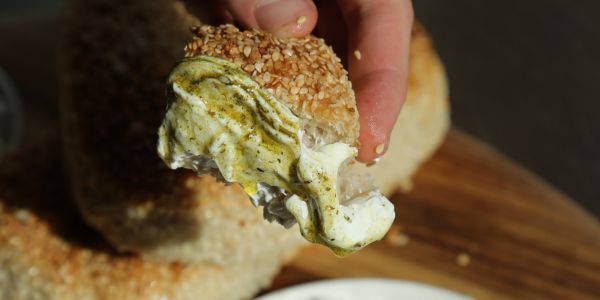
A fresh Jerusalem Bagel doesn't need to be toasted either. If you're ripping and dipping it in labneh or schmear, untoasted is the way to go. But a nice thing that happens when you toast a J-Bagel is that all those sesame seeds turn golden and deeply nutty, and the bagel toasts without drying out.
A day-old bagel of either kind belongs in the toaster.
How we eat them
At Razava
Every bagel sandwich on our menu comes on a Razava Bagel, and you can swap in a Jerusalem Bagel for any of them. The simplest is a bagel and schmear, and we make six: EVOO, toasted caper, honey walnut, beet horseradish, salted maple, and three pepper. The rest are open-faced:
- Smoked salmon — St. James Smokehouse lox, toasted caper schmear, fire-roasted tomato, and sumac onion.
- Whitefish salad — with fire-roasted salmon, Duke's mayo, preserved lemon, and cucumber salad.
- Egg salad — with candied cowboy peppers, zhug, pickles, and onion.
- Spiced apple butter — with preserved lemon, labneh whipped cream, and oat streusel.
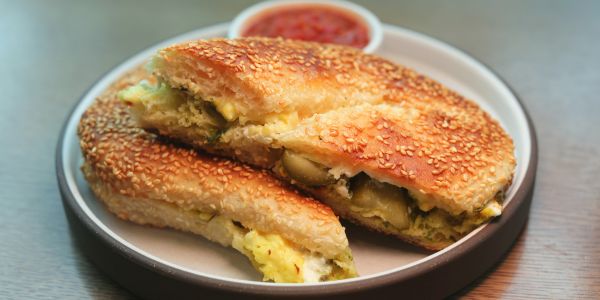
Two dishes are built around the Jerusalem Bagel alone. The J-B.E.C. is a toasted Jerusalem Bagel with egg, Clover Meadow white cheddar, feta, pickles, mayo, and zhug. The Jerusalem Bagel platter is a whole bagel with labneh and plenty of olive oil and za'atar for dipping.
At home
Schmear (or butter). For a fresh Razava Bagel, don't overthink it, and be generous with how much you put on.
Smoked salmon. Build our café version with the best lox you can find: toasted caper schmear, roasted tomato, and onion.
The cucumber club. Beet horseradish schmear, cucumber, sliced tomato, pickled red onion, and sesame seeds on a Razava Bagel, for when you want something lighter.
Olive oil and za'atar. Our platter at home: tear a Jerusalem Bagel open and drag it through good olive oil mixed with za'atar, with a bowl of labneh on the side.
Bagel toast. Split a Jerusalem Bagel, load it with cheese, and press it in a panini press or hot skillet until the cheese melts and the sesame turns golden.
Pizza bagels. The best thing to do with a day-old bagel: split, toast, and top with crushed tomatoes and melted cheese. A Jerusalem Bagel has more surface area than a round one, so there's more room for sauce, cheese, and whatever else you like. Either way, it's a perfectly legitimate dinner.
Where to get sourdough bagels in the Twin Cities
Both bagels are at our bakery at 685 Grand Ave. in St. Paul, Wednesday through Sunday. Razava Bagels come in packs of four and Jerusalem Bagels in packs of three; both are also sold individually. You can also order them on DoorDash and Uber Eats, or pick them up at our neighborhood pickup locations in North Minneapolis (Wednesday), Minnetonka (Thursday), and St. Louis Park (Friday). We also deliver bagels to Radish Farm Stop, Heather's Minneapolis, Westside Wine & Spirits, and the Kosher Spot.
If you won't finish them in a day or two, freeze them. Slice them first so they go straight from the freezer into the toaster.
Both Razava sourdough. Both very much their own thing.