
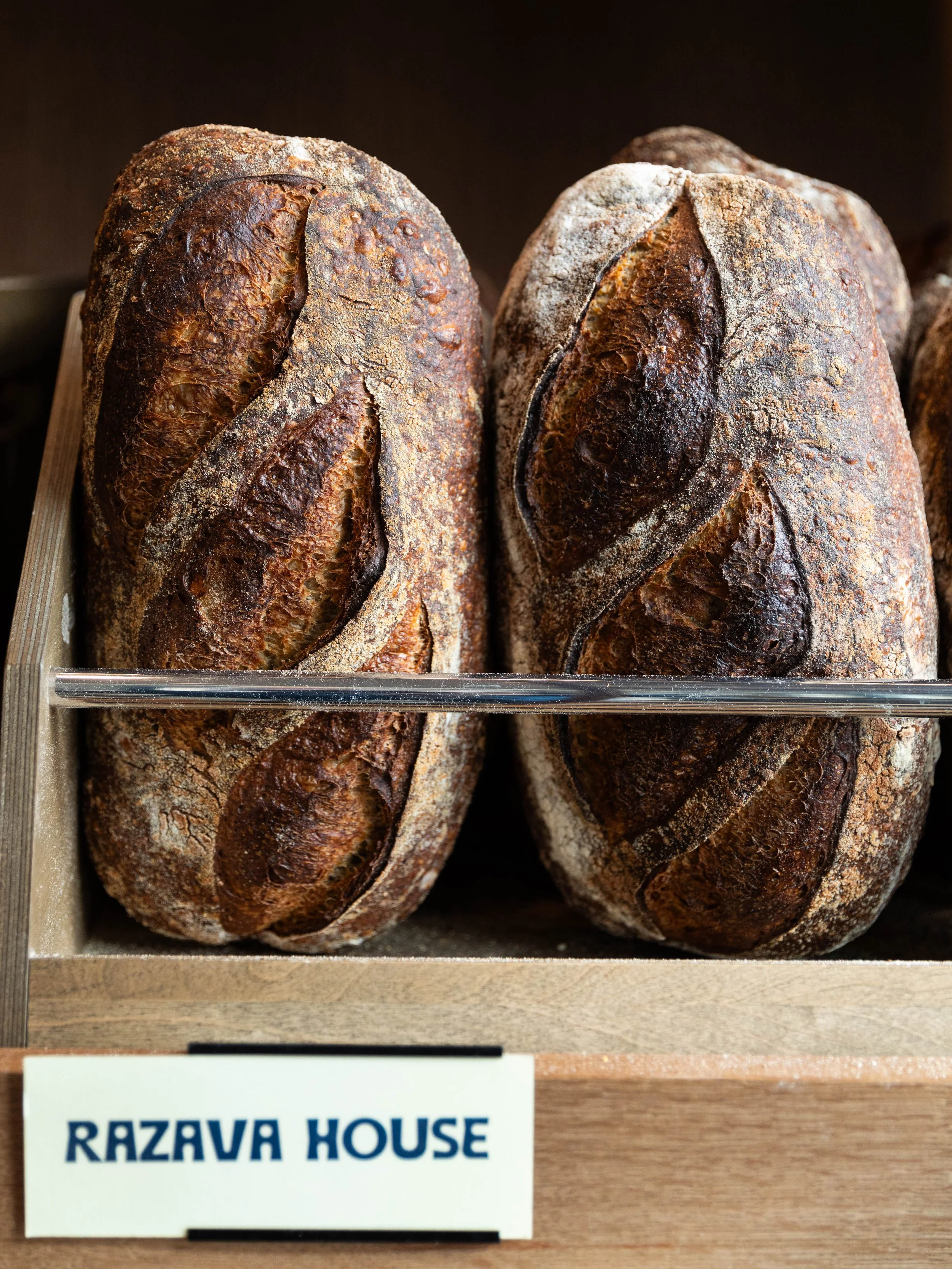
Razava House Loaf
THE BREAD IT’S ALL BUILT ON
WHY YOU’LL LOVE IT
🍞 Built for Everything
Equally at home smeared with butter at the dinner table, or built into a serious sandwich.
🌾 A Blend Like No Other
Up to a dozen grains, calibrated for a signature flavor and texture.
🧈 Sweet with a Mild Tang
The kind of bread that makes you want the next bite.
💪 Good Grain, Done Right
High-extraction flour, long fermented, digestable and flavorful.
THE STORY
You can’t make a great loaf of bread without great grain, and here in the Midwest, we have it in abundance. But great grain alone isn’t enough.
What makes a great loaf of bread is what the baker does with the grain: how it’s fermented, how its flavors are coaxed out, how different grains are combined so each brings something unique to the finished loaf.
That’s what we set out to achieve with the House Loaf, our foundational bread.
It took years of test bakes, half-percent adjustments, and the kind of painstaking calibration that most people would find unreasonable to get to the original formula for the House Loaf.
That humbling process created the blueprint for everything we bake at Razava. We strive to create sourdough breads that showcase the beauty of what different grains can do when harmoniously (some might even say obsessively!) fine-tuned, creating something even greater than the sum of its parts.
WHY WE MAKE IT
The House Loaf was born out of the search for a loaf that hits the sweet spot between wholesomeness, digestability, flavor, and versatility. A loaf that embodies the idea that good food, and food that is good for you, don't have to be two different things.
Getting there starts with the grain itself. We work closely with our farmers—Meadowlark Organics, Janie’s Mill and Farmer Direct Foods—and we take the time to understand each flour's properties, in both flavor and performance. From there, we treat the loaf like a scotch or a wine blend: combining grains so each one brings out something the others can't, and the finished loaf comes into balance.
When something changes (a crop that didn't work out, a new variety with a different character) we adjust the blend and make sure the loaf still tastes the way it’s meant to.
That consistency is its own kind of craft, and we take pride in it. It takes constant evolution to make sure the loaf in your hands today matches the one you remember from last time.
FLAVOR PROFILE & CRAFT
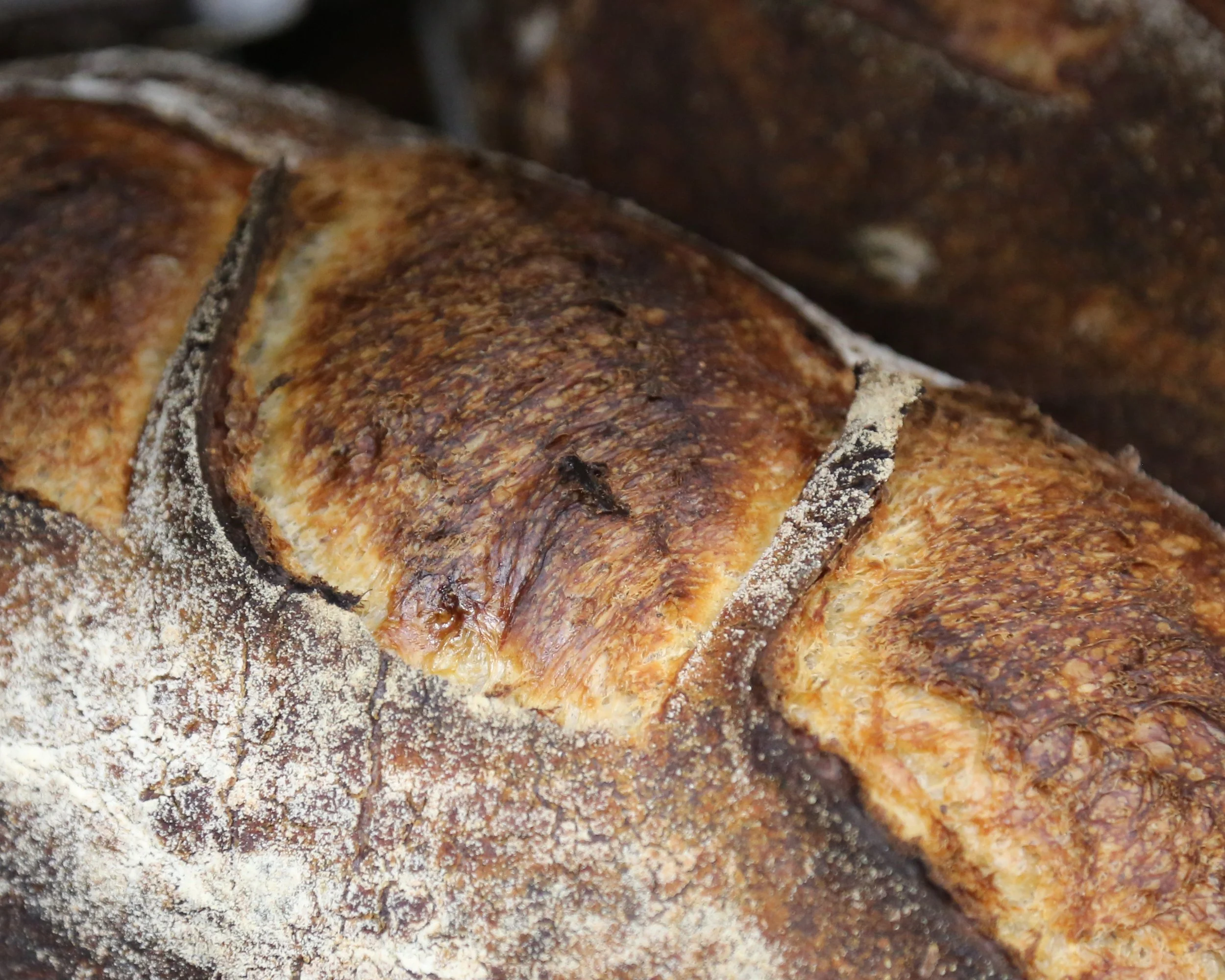
We use high-extraction flour for just about everything we bake. The whole grain is milled, then passed through a sieve once, catching the coarsest bran and letting everything else through. It's an old approach that goes by different names in different traditions: bolted, graham, first clear, depending on where and when. And it produces a flour with more flavor and more nutrition than refined white. One more old-world name for it? Razava, derived from the Polish word razowa.
The House Loaf is Razava at its most deliberate. There are between eight and twelve flours in each loaf, depending on the season. Spring and winter wheats carry the structure. Ancient grains like Banatka and Turkey Red go in as flavor accents, chosen for character. Spelt and rye add richness. A touch of oat flour offsets the bitterness of whole hard red grains, though too much starts to drag down the crumb. Every flour earns its place, and most of them are negotiating with each other.
Yes, we use mixers, but our method is designed to simulate hand mixing. The dough doesn't fully develop in the machine; it comes together just enough to promote the long fermentation that follows. We keep the starter young, the bulk ferment warm. And then the dough goes into a long, cold retard, the quiet stretch where all the elements settle into each other and the loaf finds its final character.
What you get is a bread that's sweet, with a mild acidity and an almost juicy quality. It makes you want the next bite. We've seen people young and old tear through half a loaf plain, no butter, no nothing. That's how we know the grain flavor is doing its job.
HOW TO EAT IT
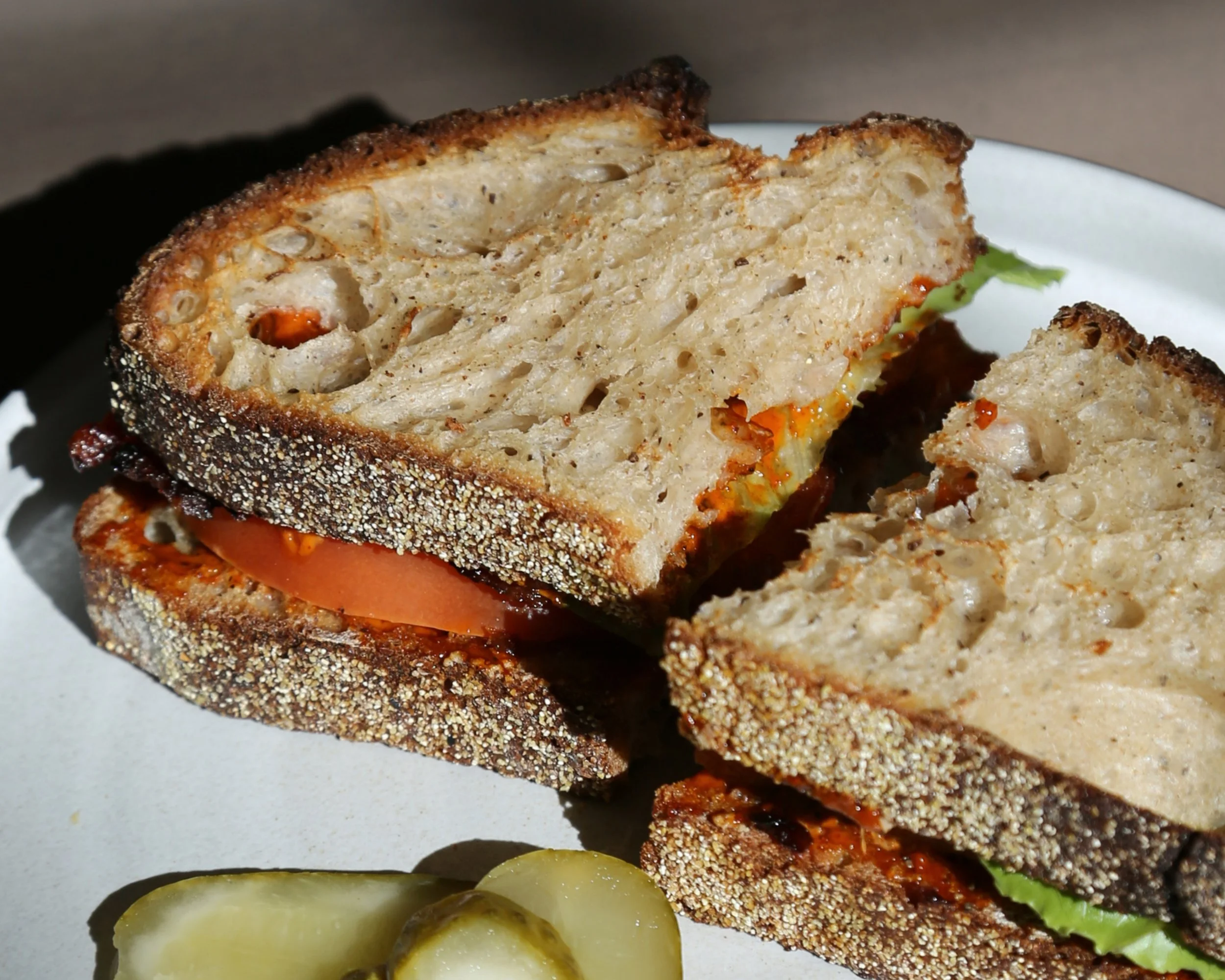
The House Loaf is at its best the day it's baked. Once you cut into it, it’s good for another 2-3 days; store it in a bread box; cut-side-down on the cutting board; or bag it in plastic and toast when needed.
With butter — Use the best you can find and don't go light.
Avocado toast — At Razava, we make ours with smashed avocado, zhug, dukkah, and red chimichurri.
An S.L.T. — Layer it with salmon bacon (or the real thing!), lettuce, tomato, and a mayo or aioli of your choice. (Or, come order The S.L.T. at Razava.)
With tinned fish — Lay down a thick slice of ripe tomato, and tip a whole tin of good sardines over it, oil and all.
HOW TO STORE IT
The House Loaf is at its best the day it's baked. (If you can wait until day two to slice into it, it might be even better.) Once cut into, it’s good for another 2-3 days; store it cut-side-down on the cutting board, or bag it in plastic and toast when needed.
It also freezes exceptionally well, sliced or whole. Reheat it and proceed with the section above.
WHERE TO BUY IT
You can find the Razava House Loaf every day at our bakery at 685 Grand Avenue in St. Paul; on DoorDash; on Uber Eats; or at one of our neighborhood pickup locations in North Minneapolis (Wednesday), Minnetonka (Thursday) or St. Louis Park (Friday).